
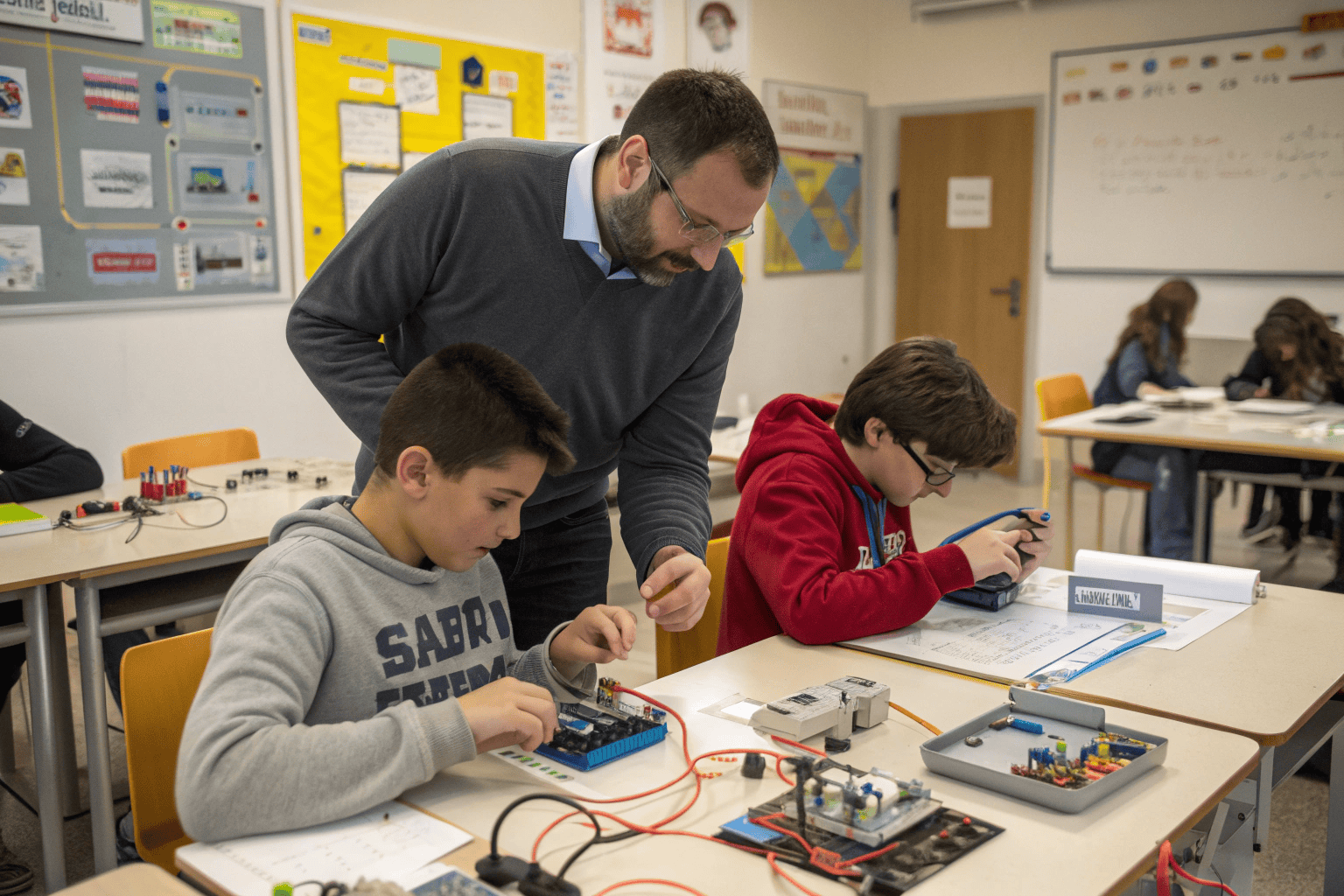
If you’ve ever stood in front of a class trying to explain coding, robotics, or circuitry — while a dozen hands shoot up asking, “Miss, mine’s not working!” — you know that teaching STEM isn’t just about experiments and innovation. It’s about patience, resourcefulness, and managing 25 mini “engineers” who all learn differently.
STEM education promises creativity, collaboration, and critical thinking — but in real classrooms, the path to those magical “aha!” moments can feel more like untangling a mess of cables (literally and metaphorically). The good news? Once you identify these hidden challenges, there are surprisingly simple ways to fix them.
Let’s unpack the real struggles no one talks about — and the classroom-tested fixes that work.
1. Challenge: Too Many Tools, Too Little Time
Teachers often face the paradox of plenty. Between robotics kits, coding platforms, 3D printers, and simulation software, choosing the right tools for a 40-minute session can be overwhelming. Add setup and cleanup time, and suddenly, half your class time disappears.
The Fix: Simplify Your Toolkit
Instead of trying to cover everything, focus on modular kits that allow easy transitions between topics. Devices like the BBC Micro:bit are great starting points — flexible enough for coding, sensors, and electronics. Pair it with a Microbit power bank or a Microbit rechargeable battery to make the setup cordless and portable. No tangled wires. No “dead battery” delays.
By streamlining your STEM toolkit, you not only reduce classroom chaos but also empower students to explore independently.
2. Challenge: The Fear Factor — “What If I Don’t Know the Answer?”
STEM intimidates even experienced teachers. The rapid pace of technology means that new tools or coding languages pop up faster than we can master them. Teachers often confess that their biggest fear is being asked a question they can’t answer on the spot.
The Fix: Shift from “Instructor” to “Co-Explorer”
The mindset shift changes everything. Instead of positioning yourself as the all-knowing expert, become a co-learner. Encourage phrases like, “Let’s test it together,” or “What do you think might happen if we try this?”
Students are often more engaged when they see their teacher experimenting, troubleshooting, and even failing — because it models real-world scientific thinking. When teachers show curiosity instead of fear, students mirror it.
3. Challenge: Keeping Students Engaged Beyond the “Wow” Moment
Every STEM teacher has experienced this: the class lights up when the robot moves or the LED blinks — but five minutes later, attention drifts. The “wow” wears off, and you’re left struggling to turn excitement into sustained learning.
The Fix: Connect Projects to Real-World Purpose
Engagement skyrockets when students see why a project matters. Instead of coding a random blinking light, ask them to create a night lamp that turns on automatically when it’s dark. Or a temperature alert system for their classroom aquarium.
When tasks have context, students stop following instructions and start solving problems. The difference is subtle but powerful — it’s the bridge between activity and understanding.
4. Challenge: Limited Resources and Uneven Access
Let’s be honest — not every school has the luxury of fully equipped labs or dozens of kits. Some classrooms share a handful of devices, and teachers are expected to “make it work.”
The Fix: Think “Team Projects,” Not “Individual Devices”
STEM doesn’t have to be one-kit-per-student. Group-based projects foster collaboration, distribute equipment fairly, and encourage teamwork — a skill that’s as important as coding.
Rotate leadership roles within teams: coder, documenter, designer, and tester. This approach turns scarcity into opportunity — every student learns from every role, not just the “hands-on” one.
5. Challenge: Balancing Theory and Hands-On Learning
Some teachers lean heavily on theory because it feels safe; others go fully practical and skip conceptual grounding. The best STEM classrooms find harmony between the two — where hands-on work reinforces the “why” behind the “how.”
The Fix: Start with Curiosity, End with Reflection
Open each lesson with a real-world question. For example:
- “Why do automatic streetlights turn on at night?”
- “How does your smartwatch measure your steps?”
Then, guide students through an experiment or build that answers that question. Close with reflection — ask them to explain what they learned and how it applies in the real world. It transforms tinkering into comprehension.
6. Challenge: Overwhelmed Teachers, Under-Confident Students
Many STEM teachers juggle multiple subjects, handle logistics, and meet curriculum targets — often without much formal training in engineering or programming. That stress trickles down to students, who sense uncertainty and mirror it with hesitation.
The Fix: Small Wins and Peer Support
Start small. Instead of full-fledged projects, introduce bite-sized challenges — a five-minute build, a one-line code change, a quick debug exercise. Celebrate every success loudly.
Also, create “student experts.” When a child masters a skill (like coding an LED sequence), have them teach peers. It builds confidence, community, and reduces the teacher’s load.
7. Challenge: Sustaining Momentum Beyond the Classroom
The final hurdle? Keeping STEM alive once the bell rings. Students might love coding in class but forget about it at home. Without reinforcement, even the most engaging lessons fade quickly.
The Fix: Give Students Takeaway Challenges
Encourage simple at-home experiments using household materials or online simulators. Let them record videos of their projects or write mini reflection notes.
Better yet, host monthly “STEM Show-and-Tell” days. Students bring something they built, coded, or researched outside class. It’s informal, fun, and keeps curiosity alive.
The Bigger Picture: Teachers as Innovators
Behind every successful STEM program is not a fancy lab — it’s a teacher who refused to give up when the Wi-Fi crashed, the battery ran out, or the code wouldn’t compile.
STEM teaching is less about technology and more about mindset. When teachers embrace creativity, flexibility, and imperfection, they don’t just teach science — they model resilience.
And that might just be the most valuable lesson any student can learn.
Final Thought:
STEM classrooms don’t need to be perfect. They just need to be alive — buzzing with trial, error, laughter, and lightbulb moments. Equip your students (and yourself) with the right tools, a bit of patience, and a dash of curiosity, and you’ll see that even the hardest challenges come with simple, teachable fixes.